Sustainable Beef Production with Interbev
30th June 2025
SAI Platform Annual Event 2025
During SAI Platform’s 2025 Annual Event, Interbev hosted a field visit to two pioneering French farms demonstrating that sustainable beef production is already having a positive impact on soil, animals, and rural communities.
- At Ferme de la Recette, rotational grazing and homegrown feed are restoring soil, cutting costs, and reducing reliance on external inputs.
- Ferme d’Arcy turns farm waste into renewable biogas, while smart sensors and kefir diets are boosting animal welfare and meat quality.
- The visits highlighted that farmers are ready to lead the transition, but need fair prices, policy support, and greater recognition of extensive farming systems.
Tradition and Regeneration at Ferme de la Recette
The day began at Ferme de la Recette, where farmer Philippe Dufour is leading a regenerative transition on his 135-hectare farm. With 90 Blonde d’Aquitaine suckler cows grazing on diverse, rotating pastures, the farm enhances soil health and biodiversity while maintaining a sustainable, closed-loop feeding system using homegrown cereals, hay, and alfalfa. Participants observed how thoughtful pasture management not only improves soil fertility but also reduces input reliance, an underused but highly effective tool in regenerative beef systems.
Innovation and Integration at Ferme d’Arcy
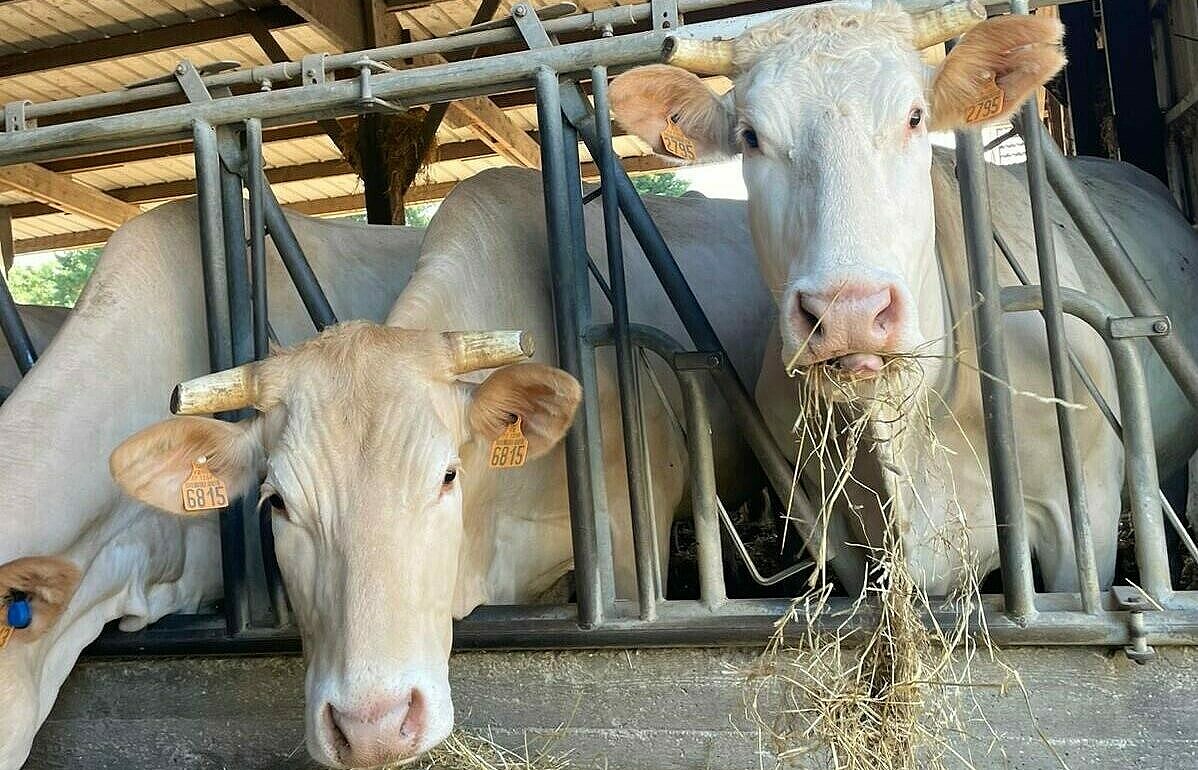
In the afternoon, participants visited Ferme d’Arcy, where brothers Jacques-Pierre and Mauritz Quaak are reimagining what modern, sustainable beef production looks like. Across 360 hectares, the farm integrates 150 Limousine cows with a diverse crop rotation and a pioneering methanization unit, the first of its kind in France, turning livestock waste and crop residues into renewable biogas. This closed-loop system captures carbon, reduces reliance on chemical inputs, and provides clean energy back to the farm, while also improving soil fertility and resilience to climate pressures.
Participants were particularly impressed by the farm’s use of sensor-based ear tags to monitor animal health and the integration of kefir into cattle diets, both of which contribute to improved animal welfare and meat quality. These natural and targeted methods exemplify how innovation can support both productivity and sustainability in the beef sector.
Key Takeaways: Empowering Farmers, Supporting Transitions
Throughout the visit, a strong message emerged: farmers are willing and eager to make the transition to regenerative agriculture, but they need to be supported, not dictated to. Psychological, financial, and policy-related barriers remain, and shifting these will require systemic support. Key levers identified included fair pricing for sustainably produced meat, better recognition of extensive farming systems, and policy frameworks that incentivise regenerative practices, such as tax reforms that no longer favour intensive plough-based farming.
One underused yet powerful tool discussed was pasture rotation, which enhances soil health and carbon sequestration while reducing input needs. As both farms demonstrated, integrating this practice into beef systems offers a clear path forward but greater awareness and support are needed to drive wider adoption.
By the end of the day, participants left with a renewed understanding that beef, when produced regeneratively, can be part of the climate and biodiversity solution rather than the problem.
Whether through high-tech innovation or time-tested rotational grazing, these farms demonstrate that regenerative beef isn’t just a future aspiration, it’s a viable, impactful reality already taking root, proving that beef can be a force for environmental, economic, and social good.