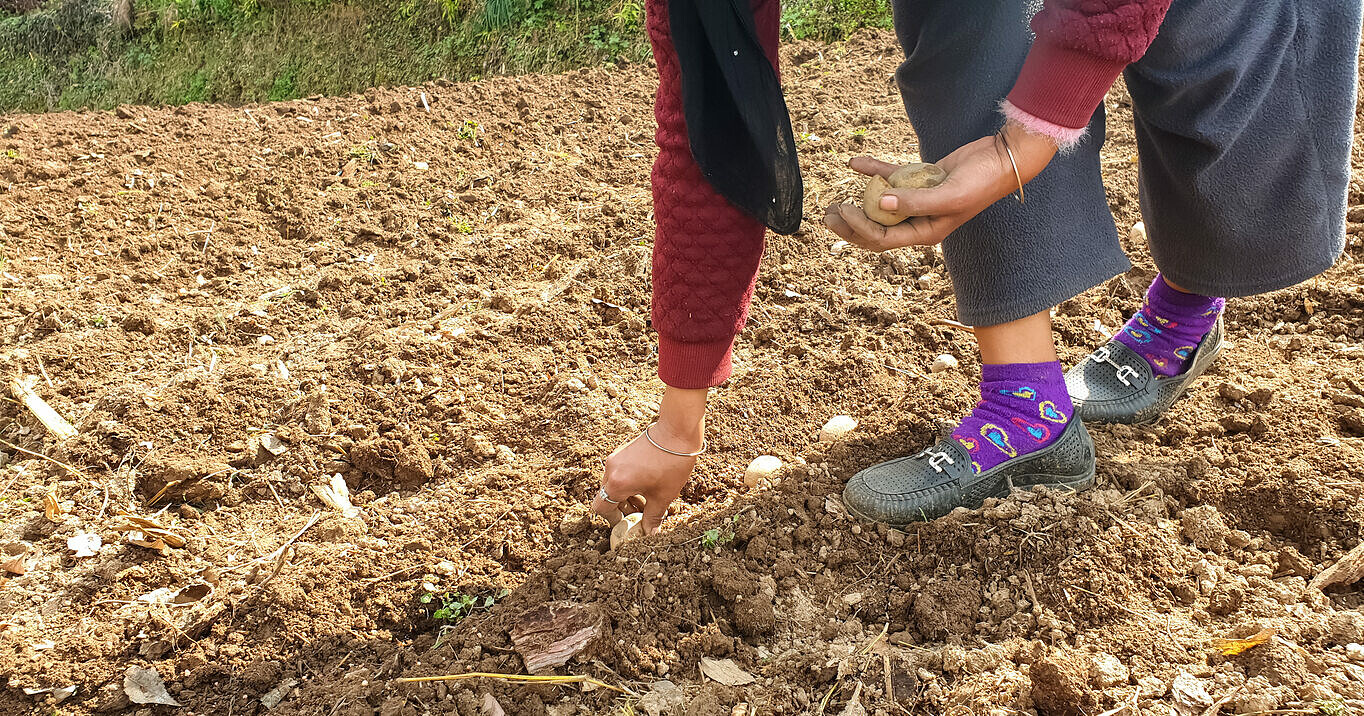
SAI Platform has published a case study showing that the Regenerating Together (RT) framework can guide regenerative agriculture on smallholder farms, not only large-scale operations. The pilot took place in December 2025 in McCain Foods Limited‘s and PepsiCo‘s potato supply chains in Gujarat and West Bengal, India. It formed part of the Co-creating Scalable Regenerative Agriculture Solutions with Smallholder Farmers project, co-funded by The Rockefeller Foundation and implemented in partnership with the International Potato Center (CIP) and 60 Decibels.
“Regenerative agriculture has to start from the realities of each farm. This pilot shows the Regenerating Together framework can do that on a one-acre plot as well as a large estate, giving companies a practical way to scale regenerative practices across their whole supply chain”
Bastian Mengel, Regenerative Agriculture Manager at SAI Platform.
The RT framework is an industry aligned global reference for regenerative agriculture designed to adapt to any production system. The pilot tested its first two modules, Context Analysis and Outcome Selection, on farms measured in single acres, and assessed how effectively these link to existing field-level practices and capacity-building initiatives already supported by McCain Foods Limited and PepsiCo. Although both regions grow potatoes, the analysis revealed very different risks. In semi-arid Gujarat, groundwater depletion was the most pressing concern. In humid West Bengal, open furrow irrigation made pesticide and nutrient leaching the highest risks. Each region therefore arrived at its own priority outcomes, from water stewardship in Gujarat to optimised crop protection in West Bengal.
Both companies already run farmer programmes that address these outcomes. McCain Foods Limited uses its Regen Farm in Gujarat as a learning hub for micro irrigation, cover cropping and crop diversity. PepsiCo uses an in-field demonstration approach and pictorial handbooks to help farmers in West Bengal adopt integrated pest management and precision nutrient management. Both companies further support farmers through their existing network of locally specialised agronomic advisors.
The case study concludes that the RT framework bridges the gap between global regenerative agriculture goals and local implementation. It keeps efforts targeted at the most pressing local issues, gives companies a clear rationale for choosing relevant and appropriate on-farm practices, and works across both large-scale and smallholder systems.
The result is a structured pathway for companies to build context-specific Continuous Improvement Plans that stay practical, locally relevant and capable of guiding farmer engagement and driving measurable environmental outcomes, regardless of size, commodity or geography.